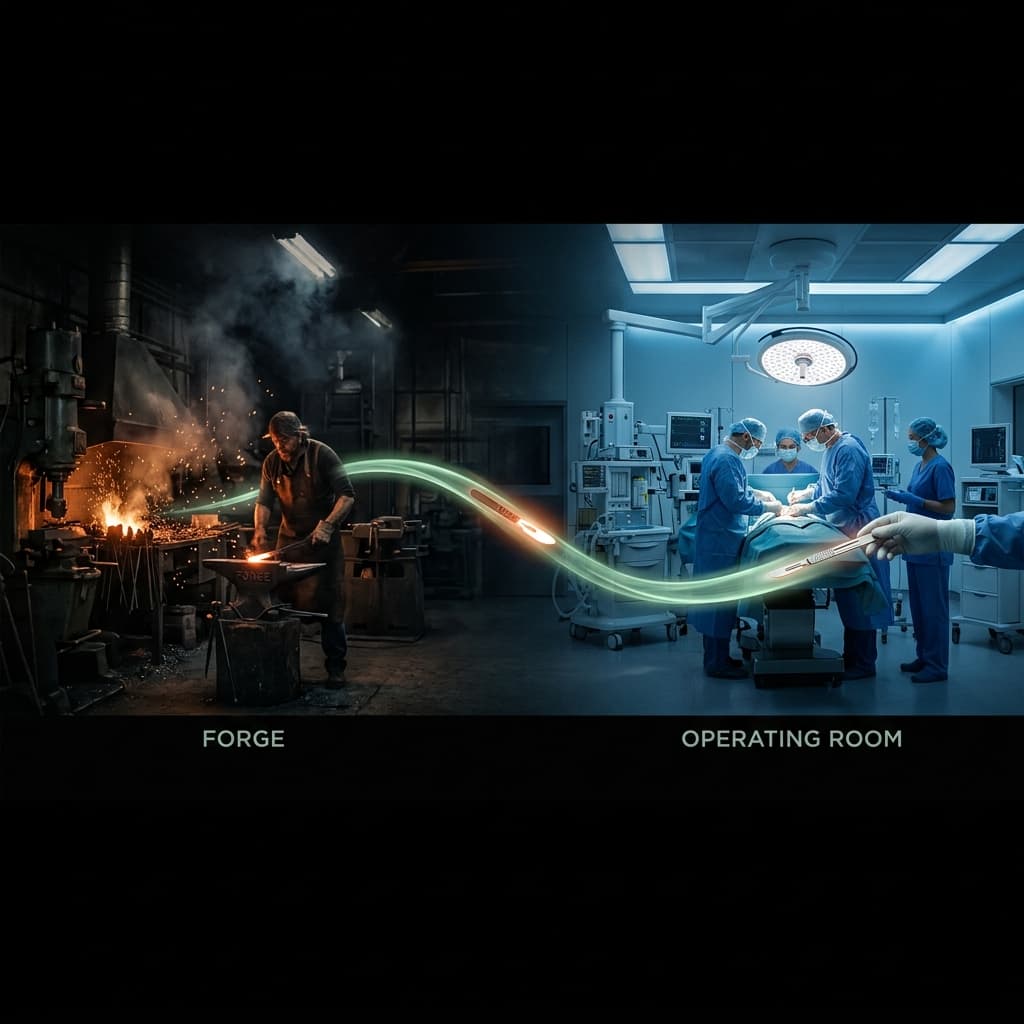
The Genesis of Precision: Why Sialkot?
When you hold a perfectly balanced, razor-sharp scalpel in an operating room, it is highly likely that its journey began over 7,000 miles away in the industrial heart of Pakistan. The term surgical instrument manufacture in Sialkot is not just a geographical descriptor; it is an internationally recognized standard of metallurgical excellence. But how exactly does a raw billet of steel transform into a critical life-saving tool? This comprehensive guide traces that exact journey.
Step 1: Metallurgical Sourcing and The Importance of AISI 410
The journey begins long before the furnaces are lit. The foundation of any premium surgical instrument is the steel. Sialkot manufacturers like Sialcraft do not compromise at this stage. We source high-grade, corrosion-resistant stainless steel—primarily AISI 410 and AISI 420 martensitic stainless steel—imported directly from premier mills in Japan and Germany.
Why imported steel? The surgical environment is harsh. Instruments must survive repeated exposure to saline, blood, high-heat autoclaves, and aggressive enzymatic cleaners. Subpar steel will pit, rust, and ultimately fail. By starting with certified J2 steel, Sialkot manufacturers ensure the foundation is flawless.
Step 2: The Art and Science of Forging
Once the steel arrives at the Sialkot facility, the transformation begins in the forging department. Here, the raw steel rods are cut to length and heated in massive induction furnaces to temperatures exceeding 1000°C (1832°F) until they glow a brilliant, translucent orange.
At this exact temperature, the steel is malleable enough to be shaped but retains its structural integrity. Using massive pneumatic drop hammers, the glowing steel is slammed into custom-machined steel dies. This violent, high-pressure process forces the steel into the rough shape of a scalpel handle (like the standard No. 3 or No. 4). More importantly, the forging process aligns the grain structure of the metal, significantly increasing its tensile strength compared to simply casting or cutting the shape.
Step 3: CNC Machining and Micro-Tolerances
A scalpel handle is useless if the disposable surgical blade does not attach securely. If the fit is too loose, the blade will wobble, jeopardizing the surgeon's incision. If it is too tight, the surgical technician risks injury while attempting to snap the blade into place.
To achieve this perfect fit, the rough-forged handles are moved to a clean, climate-controlled CNC (Computer Numerical Control) machining center. Here, automated robotic mills carve the intricate fitting slots with microscopic precision. Sialcraft utilizes advanced 5-axis CNC machines imported from Switzerland and Japan to guarantee that every single handle out of a 10,000-piece production run is identical down to the micron.
Step 4: Heat Treatment (Hardening and Tempering)
Despite being forged and milled, the steel is not yet ready for the operating room. It must be hardened. The machined handles are placed in vacuum furnaces and heated to precise critical temperatures, then rapidly cooled (quenched). This process changes the molecular structure of the martensitic steel, making it incredibly hard.
However, steel that is too hard becomes brittle. To fix this, the instruments undergo a secondary process called tempering. They are gently reheated to a lower temperature, which relieves internal stresses and provides the necessary "flex" or toughness required for surgical procedures. Finding this perfect balance between hardness and toughness is the hallmark of master surgical instrument manufacture in Sialkot.
Step 5: Finishing, Polishing, and Passivation
With the physical properties locked in, the aesthetic and protective finishing begins. The handles undergo a series of abrasive tumbling and hand-polishing stages to remove any burrs, forging marks, or sharp edges. The goal is a perfectly smooth, non-reflective satin or mirror finish, depending on the buyer's preference.
The final, and most critical, chemical step is Passivation. The instruments are submerged in a heated bath of nitric or citric acid. This acid strips away any free iron on the surface of the tool and promotes the formation of a microscopic chromium oxide layer. This invisible shield is what makes "stainless" steel truly stainless, protecting it against rust during autoclave sterilization.
Step 6: OEM Laser Etching and Quality Assurance (ISO 13485)
Before a scalpel leaves Sialkot, it must pass rigorous quality control. Sialcraft operates under strict ISO 13485 compliance. Inspectors visually examine the instruments under microscopes, check the dimensional tolerances of the blade slots with digital calipers, and perform Rockwell hardness testing.
Once cleared, the instruments move to the laser-etching bay. Here, they are marked with the CE mark, the lot traceability number, and, critically for B2B buyers, the buyer's own OEM logo. Sialcraft specializes in private label manufacturing, allowing global distributors to market premium Sialkot instruments under their own esteemed brand names.
Conclusion: A Legacy Delivered
From a fiery forge in Sialkot to the pristine, sterile environment of a global operating room, the journey of a scalpel is a testament to human engineering and global supply chain efficiency. When medical distributors partner with tier-one manufacturers in Sialkot, they aren't just buying metal; they are securing a legacy of precision that saves lives.
Frequently Asked Questions (FAQ)
- Q: Why is Sialkot famous for surgical instruments?
A: Sialkot has over a century of generational metallurgical expertise, combined with modern CNC technology and a heavily concentrated supply chain ecosystem that allows for cost-effective, high-volume production. - Q: What does OEM mean in surgical manufacturing?
A: OEM stands for Original Equipment Manufacturer. It means Sialcraft manufactures the instruments, but they are laser-etched and packaged with your brand name and logo before export. - Q: How do you ensure quality control?
A: We adhere strictly to ISO 13485 standards, utilizing digital calipers, Rockwell hardness testers, and 100% visual inspection before passivation and packing.